


What goes on behind the scenes to ensure the history you’re reading is accurate, well-sourced, and trustworthy? We’re glad you asked.
In creating this blog, the author works diligently to conduct careful historical research, track down archival documents and period sources, and verify details with individuals who know this history best. Whenever possible, original records, contemporary newspapers, public documents, and firsthand accounts are consulted to ground each article in verifiable evidence.
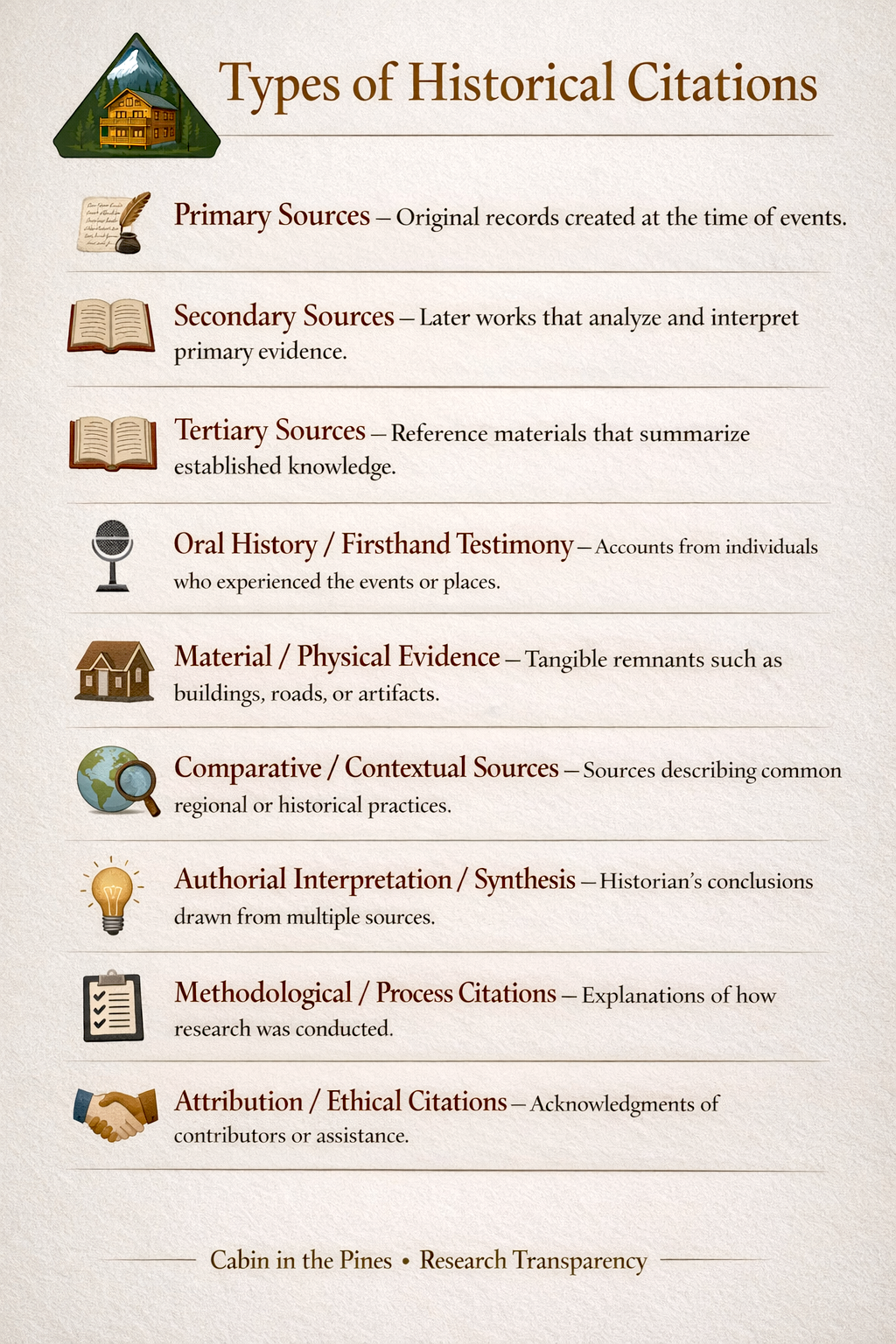
To provide clarity and credibility, footnotes and source references are included at the end of each post. These citations are offered both to document the basis for historical claims and to give readers the opportunity to explore the topics further, review original sources, and draw their own conclusions. In addition, the blog intentionally draws on multiple layers of authoritative sources, as outlined in the accompanying graphic.
As part of the research and writing process, the author also makes limited use of modern digital tools, including AI-assisted technologies. These tools are used in support roles such as research assistance, proofreading, fact-checking prompts, and stylistic refinement. They help surface potential sources, improve clarity, and identify areas requiring closer review, but they do not determine historical conclusions.
All narrative choices, analysis, synthesis of evidence, and historical interpretations are made by the author. Responsibility for accuracy, context, and any remaining errors rests solely with the author.
This approach reflects a commitment to transparency, accuracy, and responsible historical documentation while acknowledging the role that contemporary tools can play in supporting modern research and writing.
At the same time, historical understanding evolves as new sources, technologies, and research methods make additional evidence available. If readers are aware of newly available or previously inaccessible documentary, photographic, or firsthand evidence relevant to this blog, the author welcomes such material for review and possible incorporation in future updates. Revision is one of the most important advantages of a digital format.
Gene Roncone
Curator, Cabin in the Pines Blog